bij dit examen
Let op: beantwoord een open vraag altijd in het Nederlands, behalve als het
anders is aangegeven. Als je in het Engels antwoordt, levert dat 0 punten op.
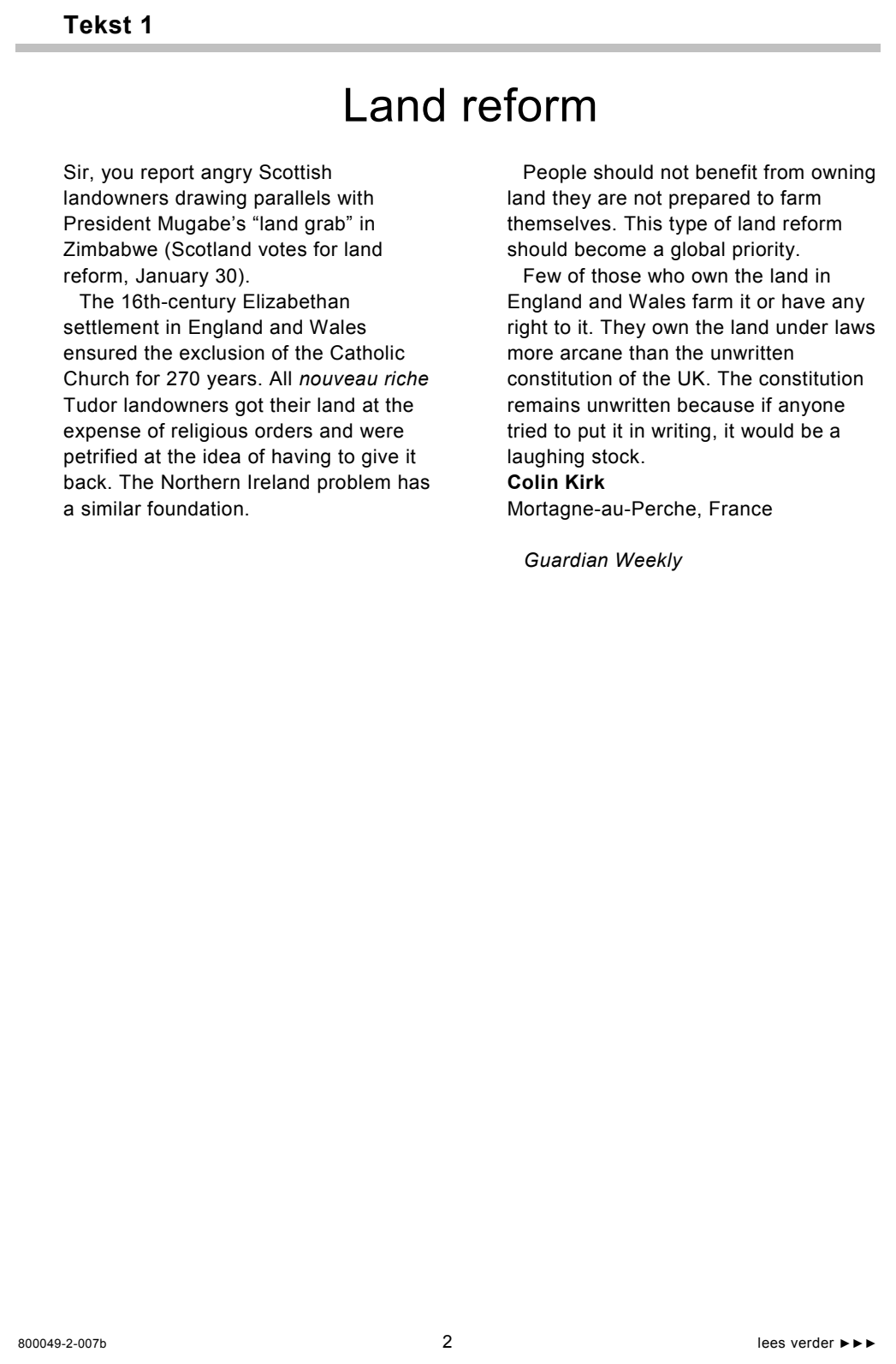
opgave 1Tekst 1 Land reform
11pWhich of the following does Colin Kirk plead for in his letter?
A Landownership should be subject to international rather than national law.
B Land taken from religious orders should be restored to them.
C Scottish legislation on land reform should also apply in the rest of the UK.
D The right to own land should be linked to the obligation to cultivate it.
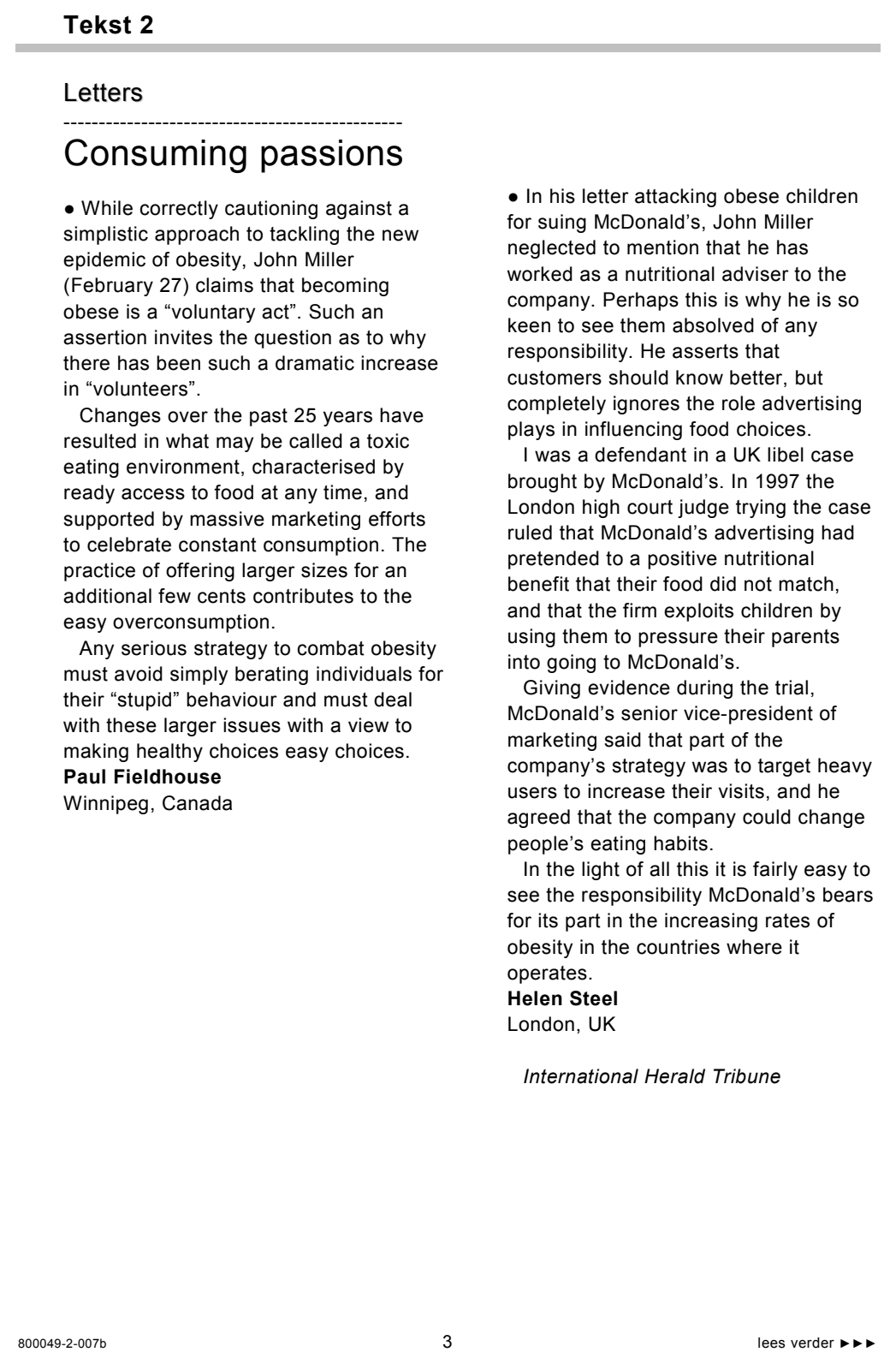
opgave 2Tekst 2 Letters: Consuming passions
21pTo which of the following do Paul Fieldhouse and Helen Steel both subscribe?
A Responsibility for obesity ultimately lies with the consumers themselves.
B Tackling the problem of obesity includes addressing the part played in it by
the food industry.
C The food industry would do itself a favour by promoting healthy choices.
D The media are reluctant to expose the influence of fast-food companies on
people’s eating habits.
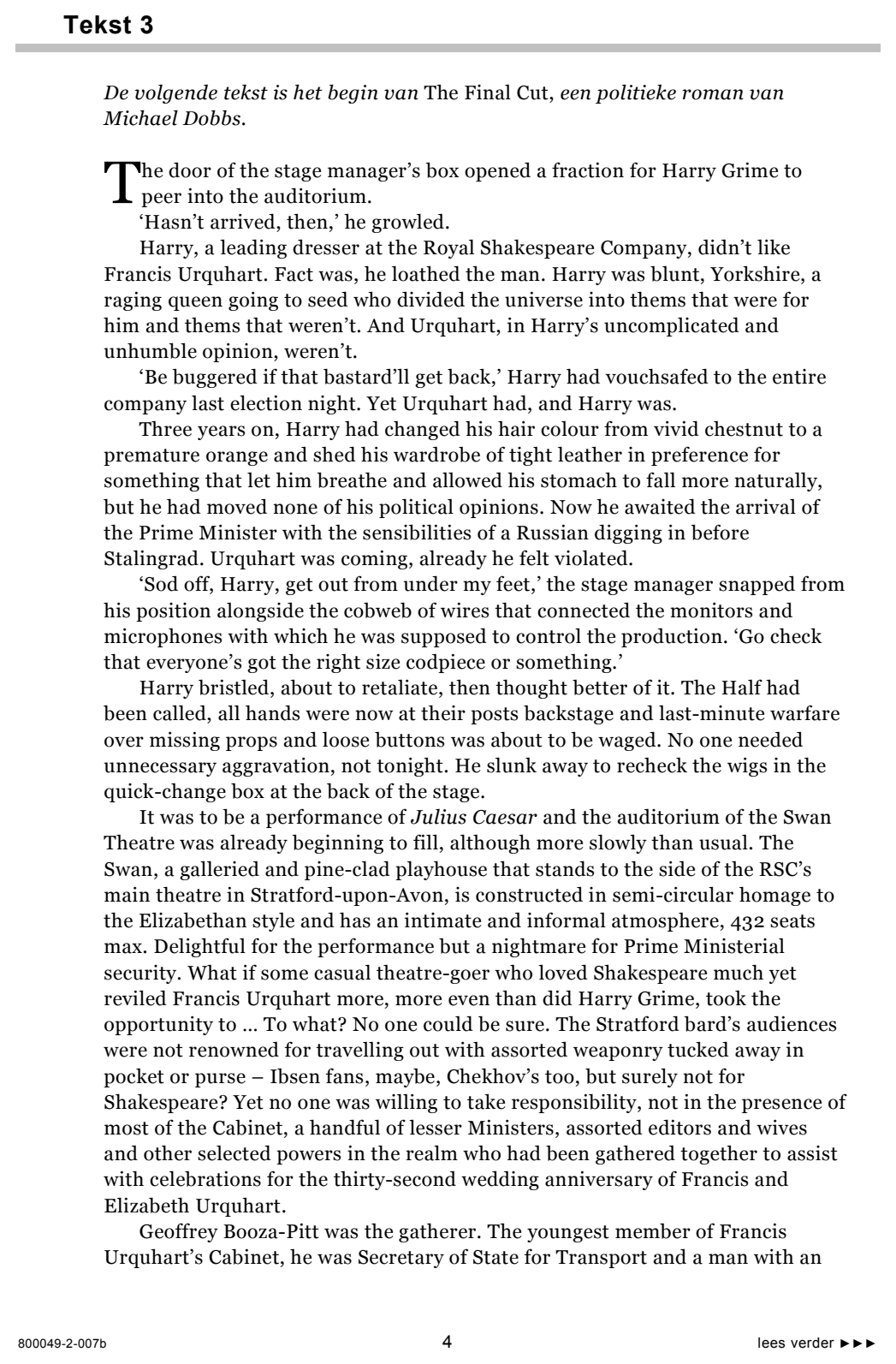
opgave 3Tekst 3 De volgende tekst…
34pGeef van elk van de volgende beweringen aan of deze met betrekking tot de
passage wel of niet juist is.
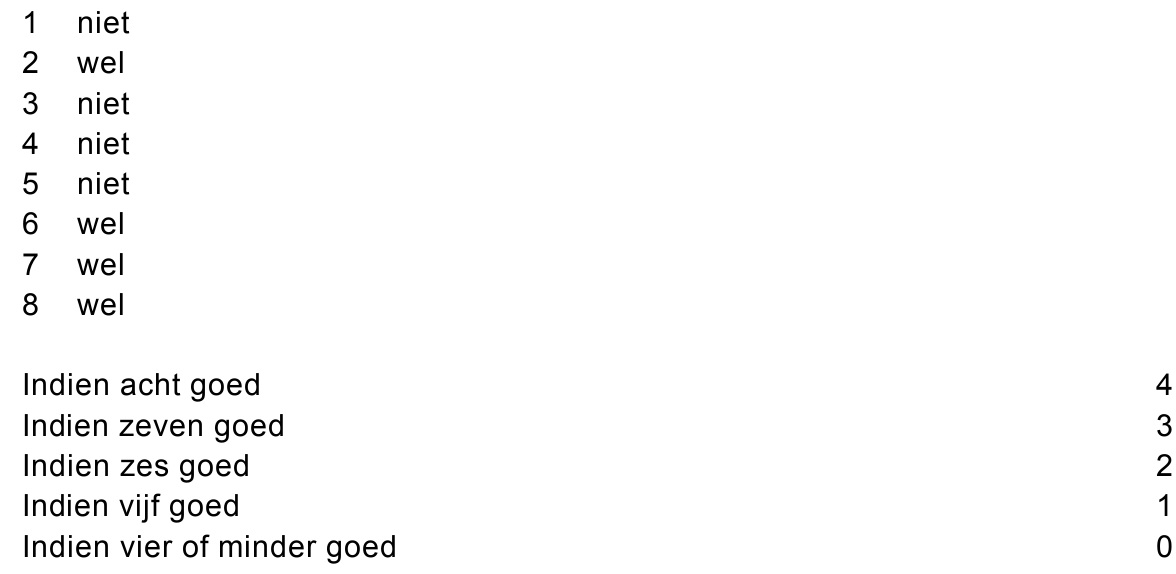
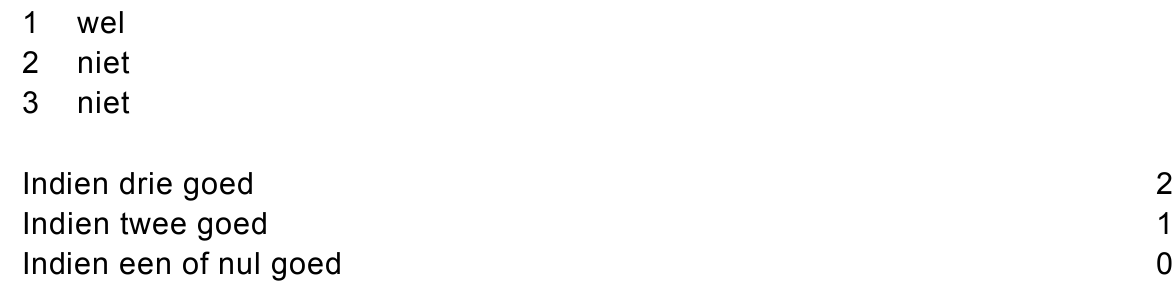
1 Harry neemt, al verkleed voor zijn rol, een kijkje in de zaal.
2 Harry had verwacht dat Francis Urquhart de verkiezingen zou verliezen.
3 Door de spanning vlak voor de opvoering ontstaat er ruzie tussen de
toneelmeester en Harry.
4 De veiligheid van de hoge gasten is te weinig een punt van discussie
geweest.
5 Julius Caesar wordt exclusief voor Francis en Elizabeth Urquhart en hun
gasten opgevoerd.
6 Geoffrey Booza-Pitt heeft eigen belangen bij de organisatie van de
feestelijke gelegenheid.
7 Het bedrijf dat de kaartjes heeft gefinancierd wordt daar in publicitair opzicht
niets wijzer van.
8 Het applaus bij binnenkomst van Francis en Elizabeth komt moeizaam op
gang.
Noteer het nummer van elke bewering, gevolgd door “wel” of “niet”.
opgave 4Tekst 4 Naturally, I’m not so wild about the concrete jungle
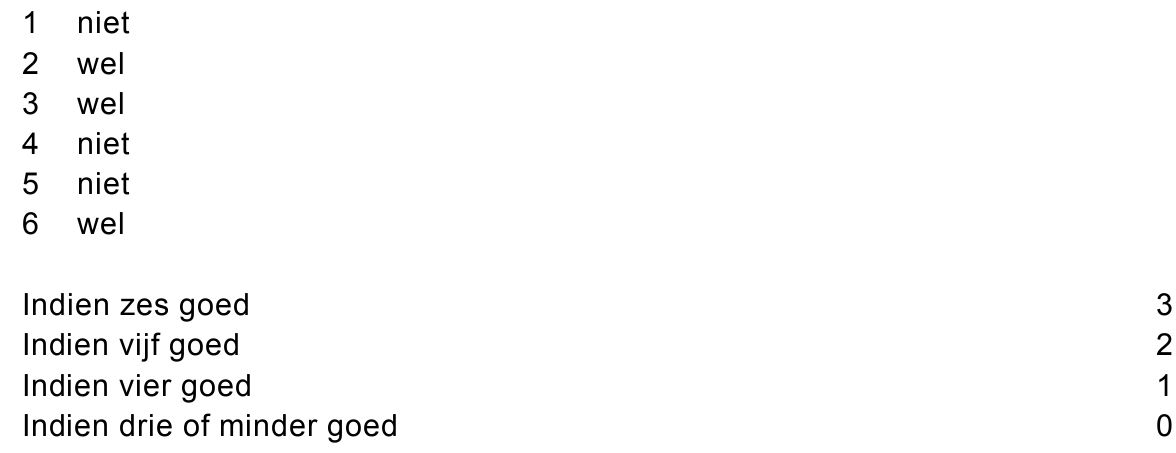
43pGeef voor elk van de onderstaande citaten uit de alinea’s 1 tot en met 4 aan of
dit wel of niet ironisch is bedoeld.
1 “a forbidding concrete housing complex”
2 “in order to reduce my litigation risk”
3 “the verdant pastures of the subterranean car park”
4 “a red, slinky and very cheeky fox”
5 “the throw-away society’s prolific output of rubbish”
6 “entertain us daily with their melodic screeching”
Noteer het nummer van elk citaat, gevolgd door “wel” of “niet”.
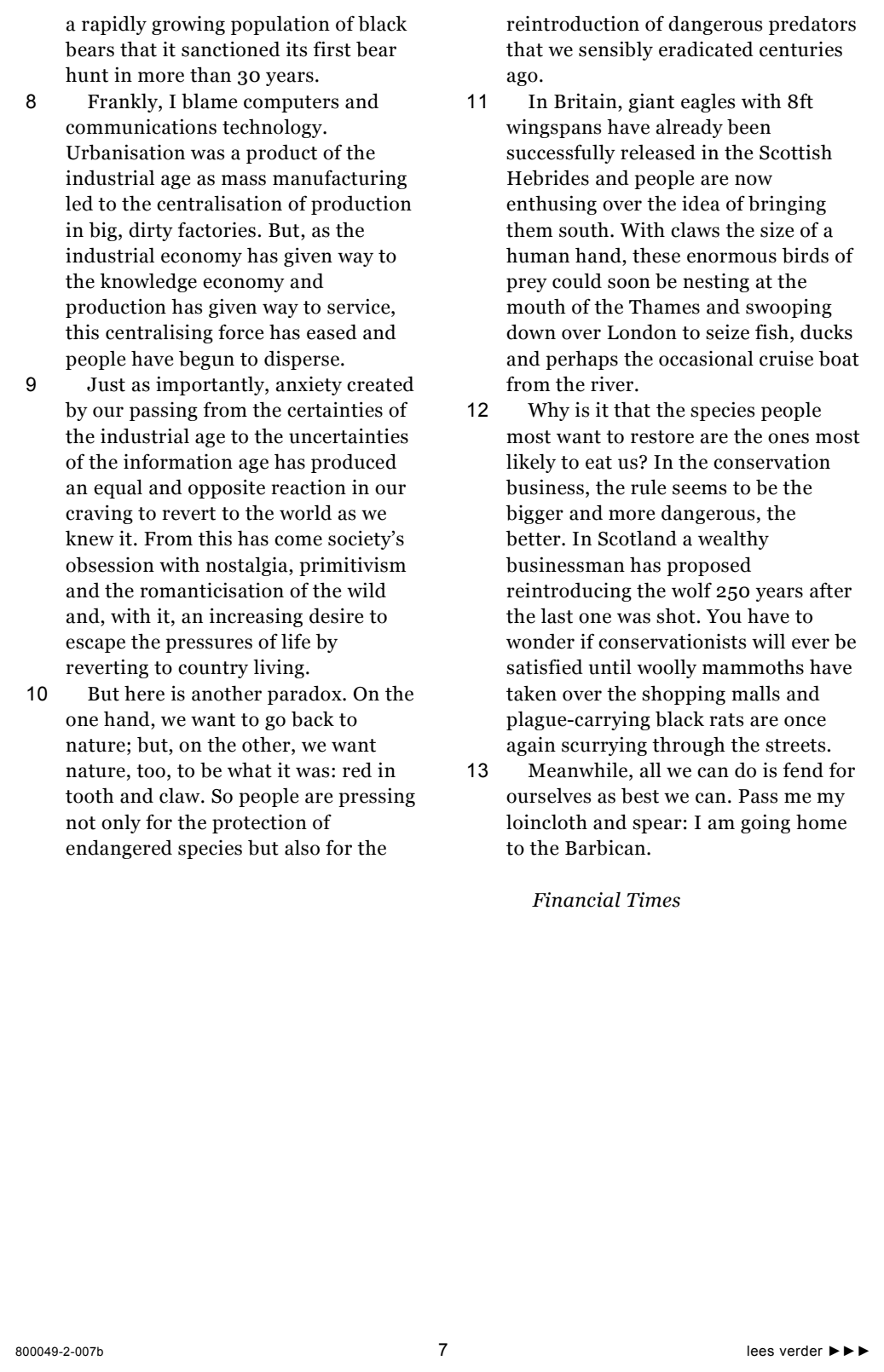
51pWhich of the following fits the gap in paragraph 3?
A Consequently
B Ironically
C To be fair
D To make matters worse
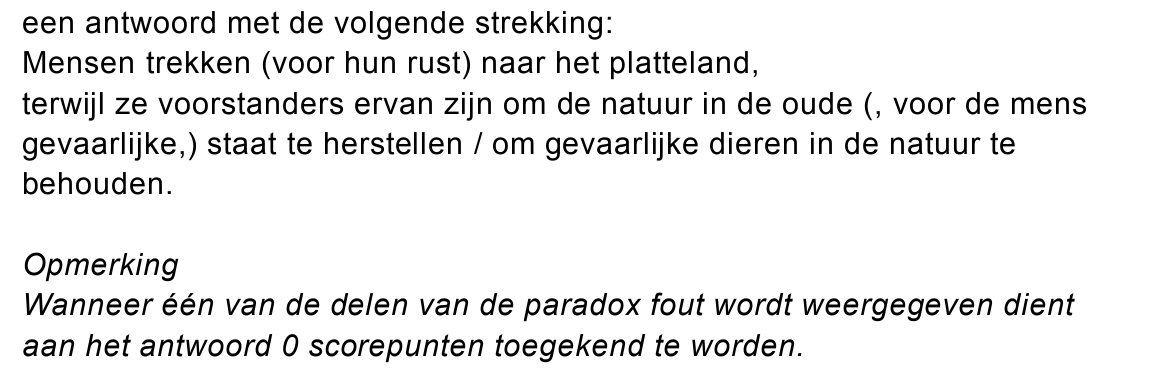
“For this is the paradox, is it not?” (paragraph 6)
61pWhich of the following does the paradox refer to?
A Damage caused by animals and a lack of effort to prevent this.
B Fear of animals and a preference for country life.
C Love of animals and abhorrence of their behaviour.
71pWhich of the following is true of the last sentence of paragraph 6 in relation to
the point made previously in the paragraph?
A It comments sarcastically on it.
B It further elaborates on it.
C It sheds a different light on it.
81pWhat does paragraph 7 describe?
A People wanting to live in the wilderness.
B Wild animals becoming dependent on people.
C Wild animals invading ever expanding urban areas.
91pWhat is the writer’s argument in paragraph 8?
A ICT is causing alienation in communities that were once close-knit.
B In the information age work no longer requires people to live in cities.
C Modern society increasingly offers room for the individual and for personal
choice.
D Pollution and hectic city life are driving people to the countryside.
101pWhich of the following is/are in line with paragraph 9?
1 Progress has led to a desire for the familiarity of the past.
2 People are willing to exchange prosperity for a materially sober way of life.
A Only 1.
B Only 2.
C Both 1 and 2.
D Neither 1 nor 2.
“But here is another paradox.” (alinea 10)
111pUit welke twee delen bestaat deze paradox?
121pWhich of the following is true of paragraphs 11 and 12?
A They emphasise that wildlife in Britain is still quite abundant.
B They illustrate that the forces of nature are beyond human control.
C They make clear that only the strongest animals of prey can survive in
modern Britain.
D They question the initiatives promoting the more extreme forms of wildlife in
Britain.
E They ridicule people for whom small and harmless animals lack all
fascination.
opgave 5Tekst 5 The fall of the Roman Empire
“If Rome hasn’t been saved by its guardian deities, it’s because they are no
longer there.” (regels 7-8)
131pWat wordt bedoeld?
Geef antwoord door op je antwoordblad de volgende zin aan te vullen:
Als de Romeinen …, dan zou het Romeinse Rijk …
142pGeef van elk van de volgende personen aan of hij wel of niet een causaal
verband legt tussen de val van het Romeinse Rijk en de aanvaarding van het
Christendom.
1 Edward Gibbon, de schrijver van The Decline and Fall of the Roman Empire
2 Peter Heather, de schrijver van het gerecenseerde boek
3 Ron Smith, de schrijver van het artikel
Noteer het nummer van elke persoon, gevolgd door “wel” of “niet”.
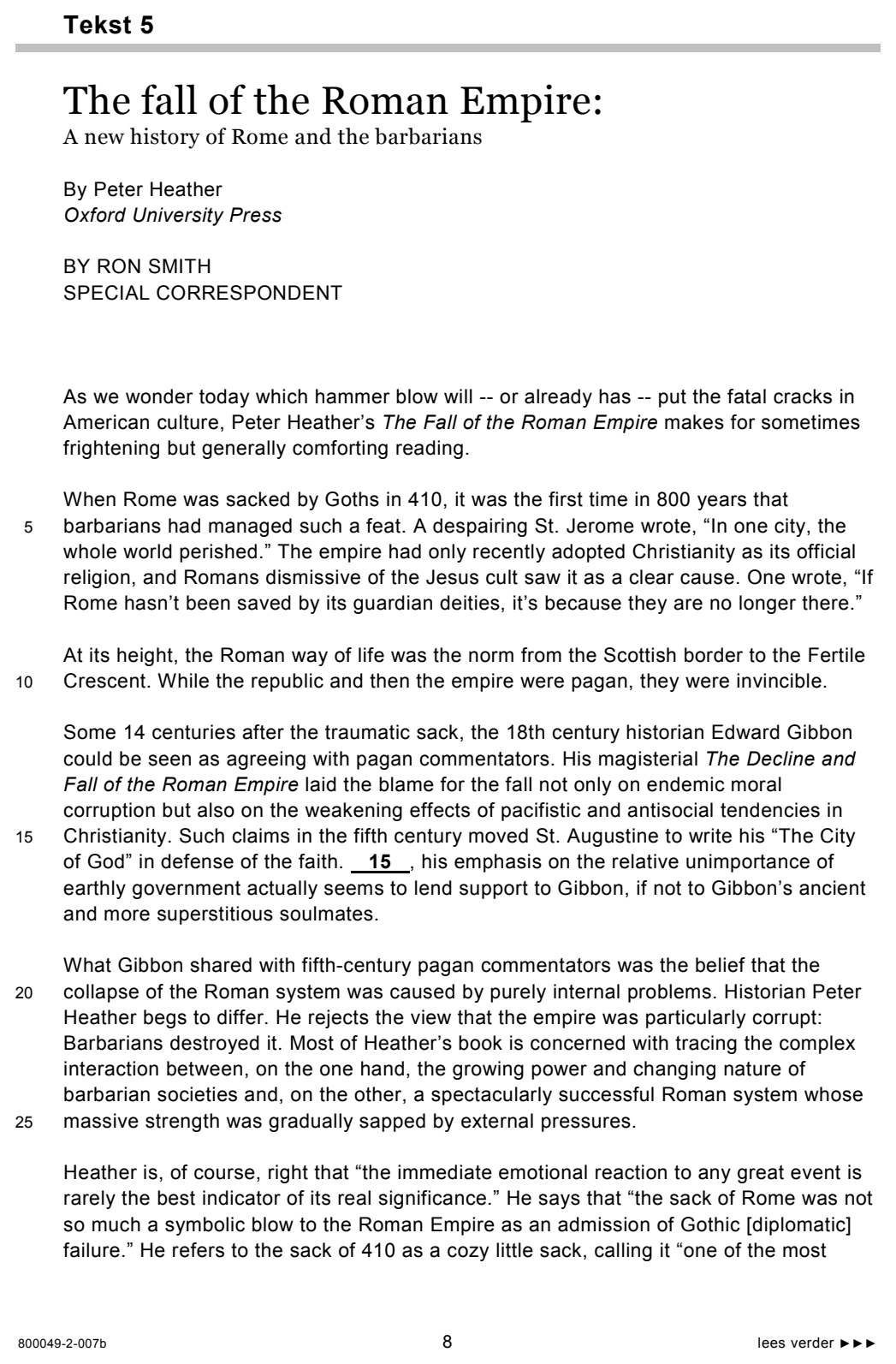
151pWhich of the following fits the gap in line 16?
A Besides
B However
C Therefore
“Gibbon’s … soulmates” (lines 17-18).
161pWho are meant?
1 “Romans … cult” (line 7)
2 “pagan commentators” (line 12)
A Only 1.
B Only 2.
C Both 1 and 2.
171pWhich of the following is not in line with Ron Smith’s review of Peter Heather’s
book?
A The book is based on a combination of academic approaches.
B The book makes some sweeping statements on the basis of questionable
claims.
C The book turns assorted bits of historical material into a coherent tale.
181pHoeveel argumenten geeft de schrijver voor “Not so new, it seems to this
general reader.” (regel 39)?
Noteer het aantal.
opgave 6Tekst 6 Hedging against the horsemen
191pWhich of the following is in agreement with what is stated in paragraphs 1-3?
A Effective aid to African peasants may come in an unlikely form.
B The famine problem can only be tackled by the countries affected by it.
C The media pay attention to only the most famine-stricken areas in Africa.
D Western countries may not really be interested in solving the problem of
famine in Africa.
“Some kind … to help.” (beginning of paragraph 4)
201pHow?
A It could be used to help peasants build up a reserve for emergencies.
B It could enable the WFP to provide food when crop failure is imminent.
C It could make agriculture in the third world countries less reliant on rainfall.
D It could make the WFP less dependent on income from donors.
“Some kind … to help.” (begin alinea 4)
211pWelk mogelijk nadeel van dit soort verzekering wordt in het vervolg van de tekst
aan de orde gesteld?
Citeer het betreffende zinsgedeelte.
221pWhich of the following arguments supports “the scheme’s feasibility”, judging
from paragraph 6?
A Big finance likes to spread its risks.
B The scheme can count on warm support in tropical countries.
C The scheme would prevent large-scale famine.
D Western insurance companies have enough funds to cope with weather
catastrophes.
231pWhat argument against the view of “sceptics” does paragraph 7 contain?
A A civil war may be more devastating than bad weather.
B Bad weather and bad government are equally hard to tackle.
C The higher its agricultural productivity, the less likely a country is to have
bad government.
D There are no clear criteria for the quality of government.
241pWhat does paragraph 9 describe?
A The circumstances in which Ethiopian peasants produce their food.
B The reasons why Ethiopian agriculture needs to be modernised.
C The reasons why it is hard for Ethiopian peasants to break out of poverty.
251pWhich of the following applies to the way The Economist treats the WFP’s
ideas?
A It is rather critical towards them, bringing up possible problems.
B It takes a neutral stand, weighing the pros and cons.
C It takes a positive attitude, refuting possible counterarguments.
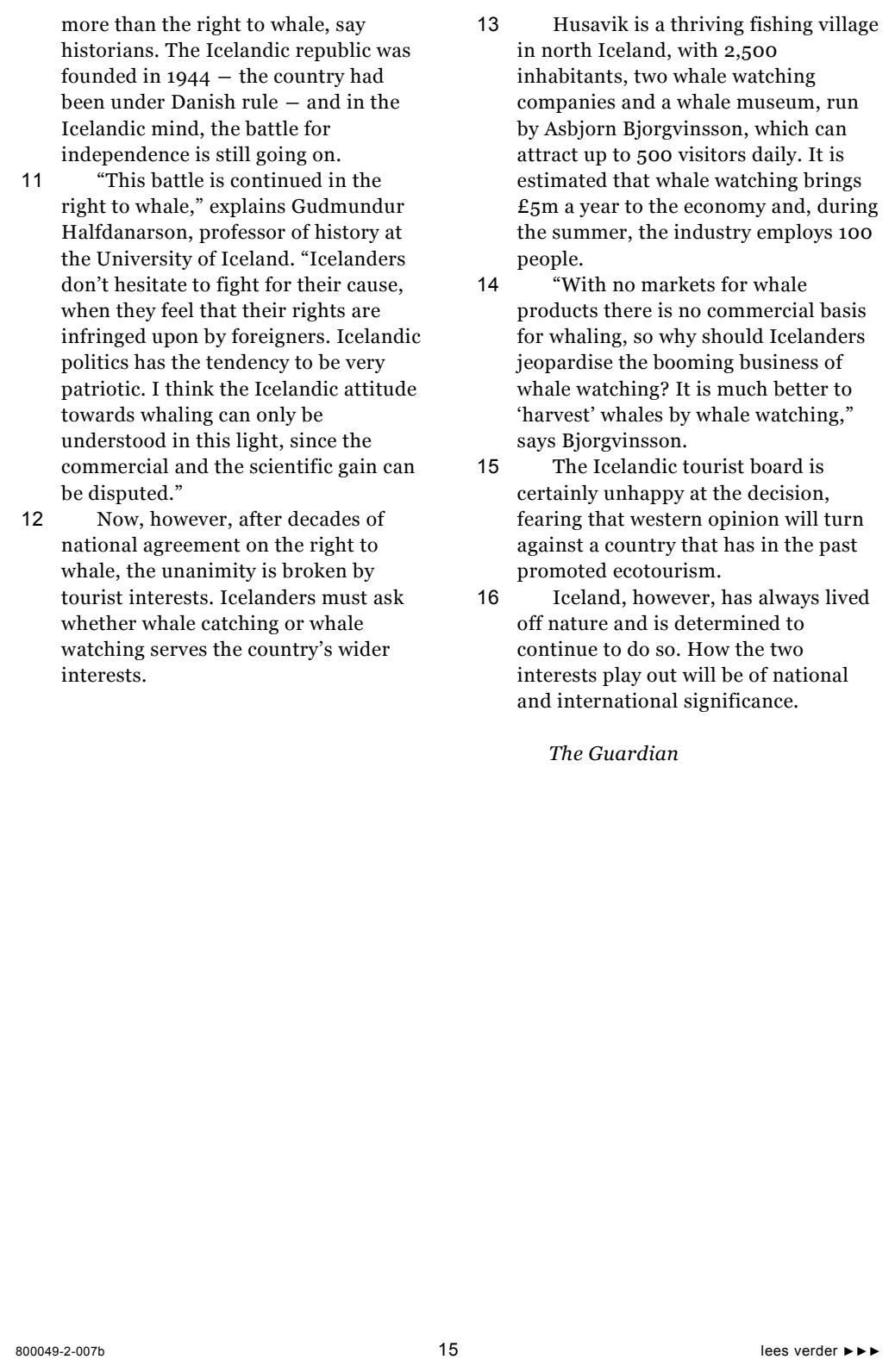
opgave 8Tekst 8 Whaling troubles
351pWhat becomes clear about Iceland’s government from paragraphs 1-3?
A It has discontinued its commercial whaling programme in favour of a
scientific one.
B It has had to take conflicting interests into account when deciding on a
whaling policy.
C It has reduced Iceland’s whaling activities in the face of public opposition.
D It is in two minds as to the economic benefit of whaling.
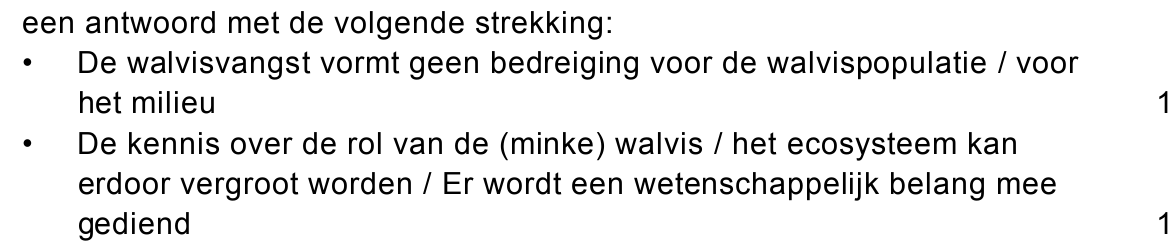
362pOp welke twee gronden verdedigt Stefan Asmundsson (alinea 4) de geplande
walvisvangst?
371pWhich of the following becomes clear about Konrad Eggertsson from
paragraphs 6 and 7?
1 He has reservations about the government plans.
2 He is determined to continue whaling regardless of government policy.
A Only 1 is true.
B Only 2 is true.
C Both 1 and 2 are true.
D Neither 1 nor 2 is true.
381pWhat is the main point made in paragraphs 8 and 9?
A Iceland has a historical right to resume its whaling activities.
B Balancing environmental and commercial interests has always been
Iceland’s prime concern.
C Whaling has traditionally played a small role in Iceland’s economy.
391pWhich of the following becomes clear from paragraphs 10 and 11?
A Iceland’s stance on whaling is emotional rather than rational.
B International interference has made Iceland’s whaling issue difficult to
handle.
C The Icelanders consider whaling an essential part of their cultural heritage.
D Whaling has always been a delicate issue between Iceland and Denmark.
“the two interests” (alinea 16, laatste zin).
402pWelke twee belangen worden bedoeld?
411pWhat is the main purpose of the article?
A To advocate restrictions with regard to the killing of whales in Icelandic
waters.
B To criticise Iceland’s decision to resume whaling for scientific purposes.
C To explain Iceland’s dilemmas with regard to whaling.
Lees bij de volgende opgaven steeds eerst de vraag voordat je de bijbehorende
tekst raadpleegt.
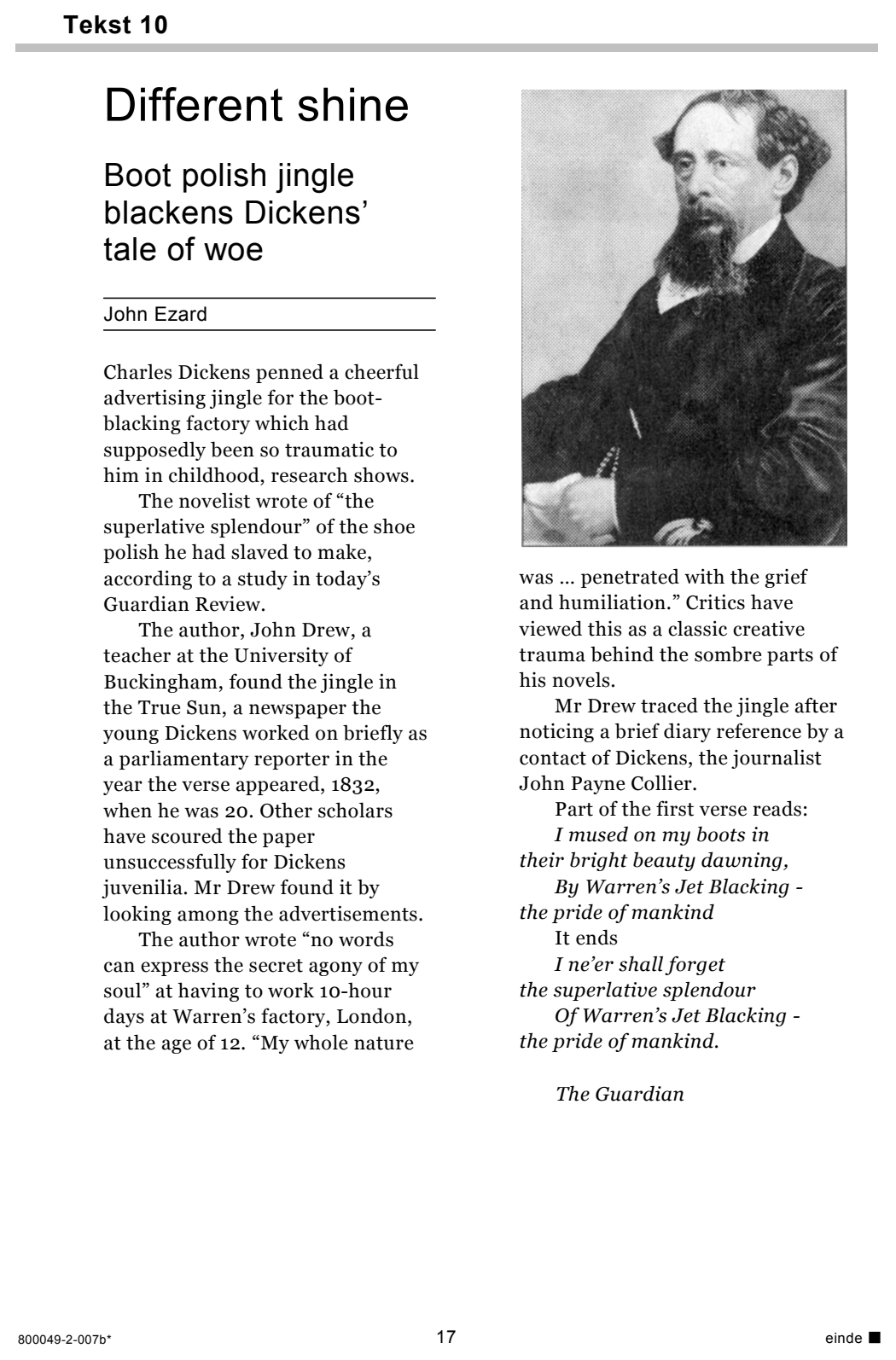
opgave 10Tekst 10 Different shine
“Boot polish jingle blackens Dickens’ tale of woe” (onderkop)
431pWaarover ging deze “tale of woe”?
Bronvermelding
Een opsomming van de in dit examen gebruikte bronnen, zoals teksten en afbeeldingen, is te vinden in het bij dit examen
behorende correctievoorschrift, dat na afloop van het examen wordt gepubliceerd.