bij dit examen
Let op: beantwoord een open vraag altijd in het Nederlands, behalve als het anders is aangegeven.
Als je in het Engels antwoordt, levert dat 0 punten op.
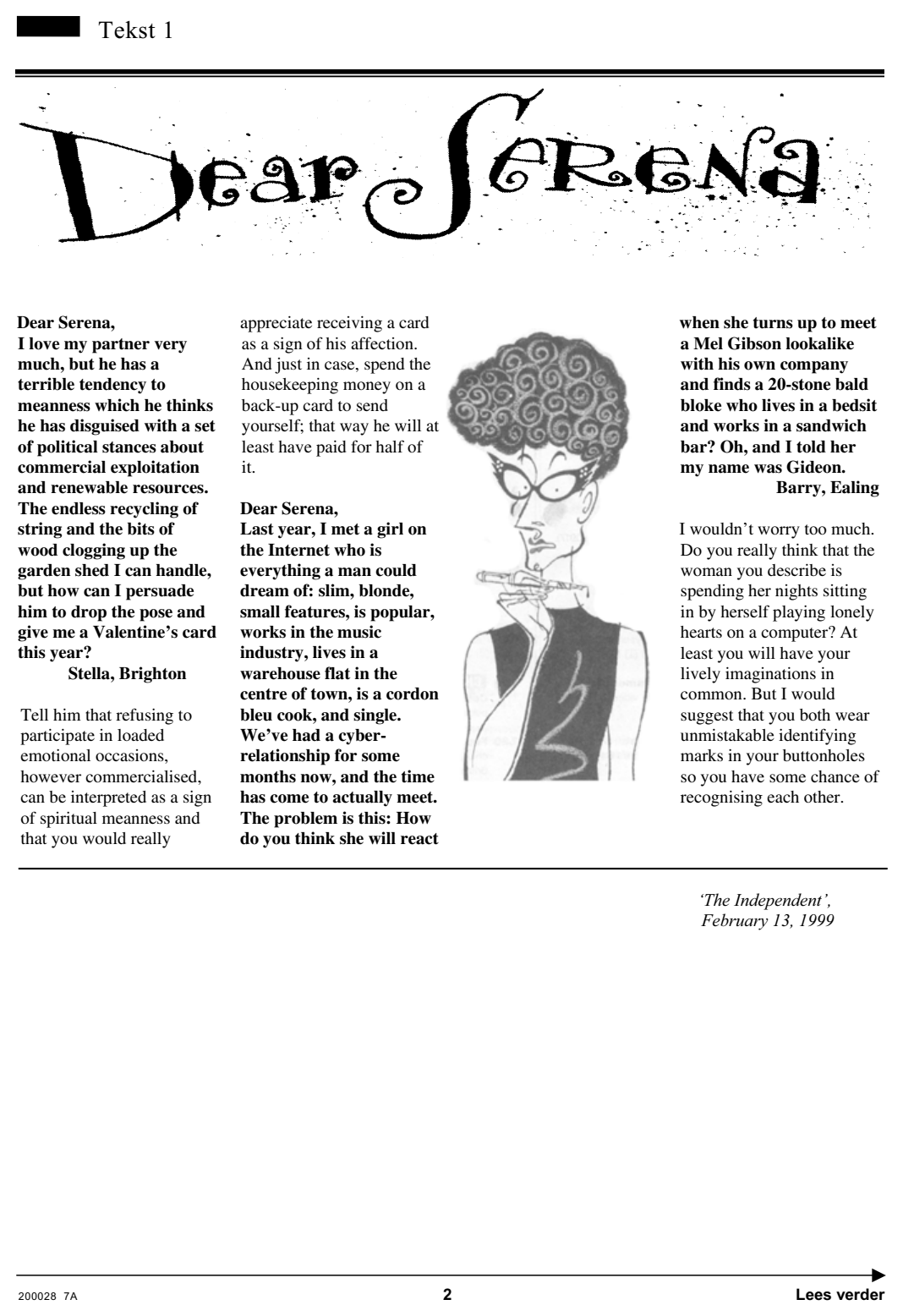
 What does Stella’s complaint about her boyfriend come down to?
 He cares too much for the environment.
 He finds it hard to spend money on her.
 He hides his true feelings for her.
 He is more interested in politics than in romance.
 What is Barry’s problem concerning the girl he has had a cyber-relation with, according to
 He envies her for having so many good qualities.
 He fears that she will be deeply disappointed when she finds out what he is really like.
 He is not sure that he loves her enough to continue having contact with her.
 He is too shy to make an appointment with her.
 What does Serena’s answer to Barry’s letter suggest?
 Serena is convinced that Barry has made up his whole story to her.
 Serena thinks that Barry’s looks, job and name are all right.
 The woman Barry wants to meet is not likely to show up at the appointed place and time.
 The woman Barry wants to meet may not be as perfect as she has led Barry to believe.
 How can the overall tone of Serena’s answer to Barry’s letter be characterised?
 As businesslike.
 As mocking.
 As surprised.
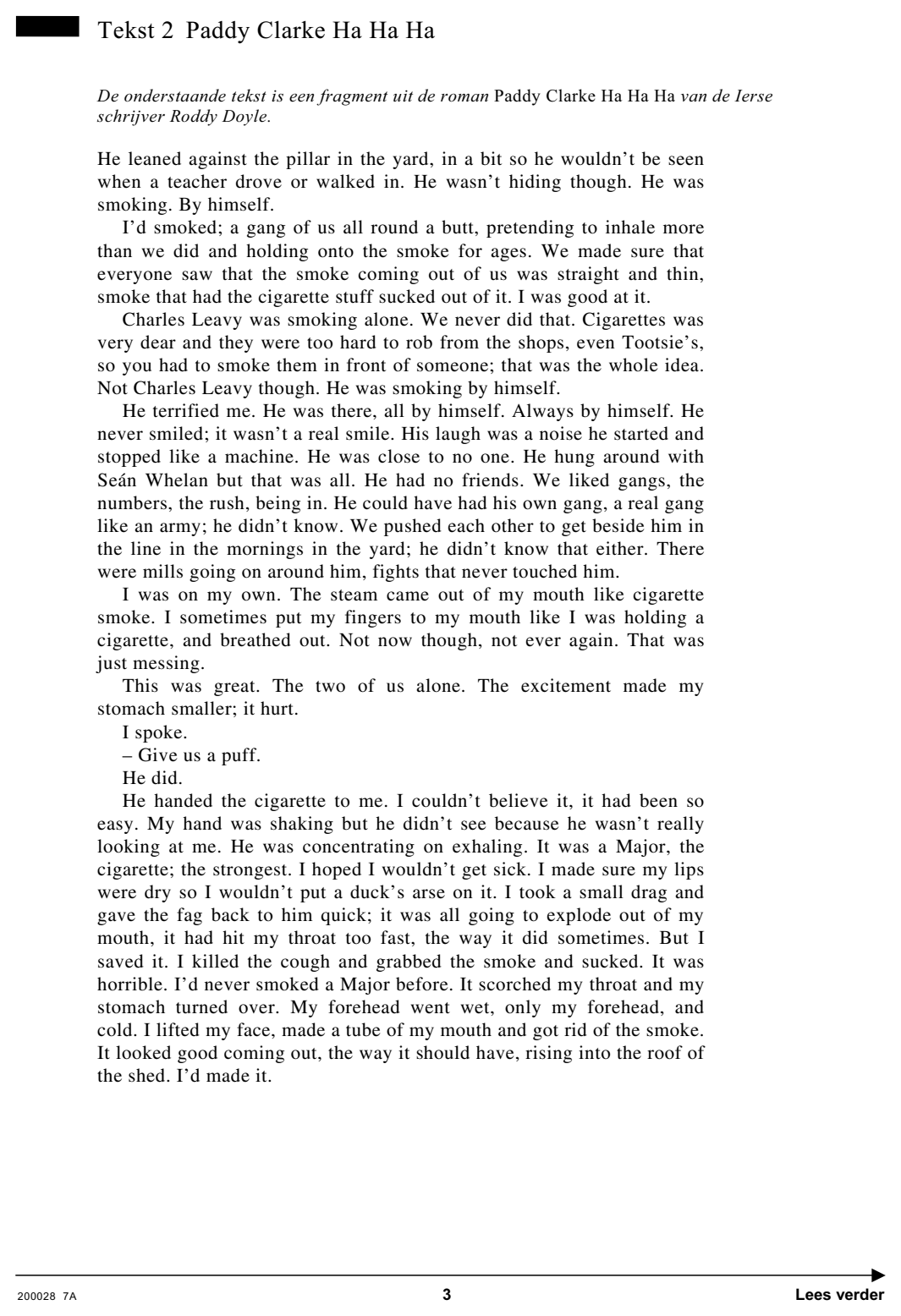
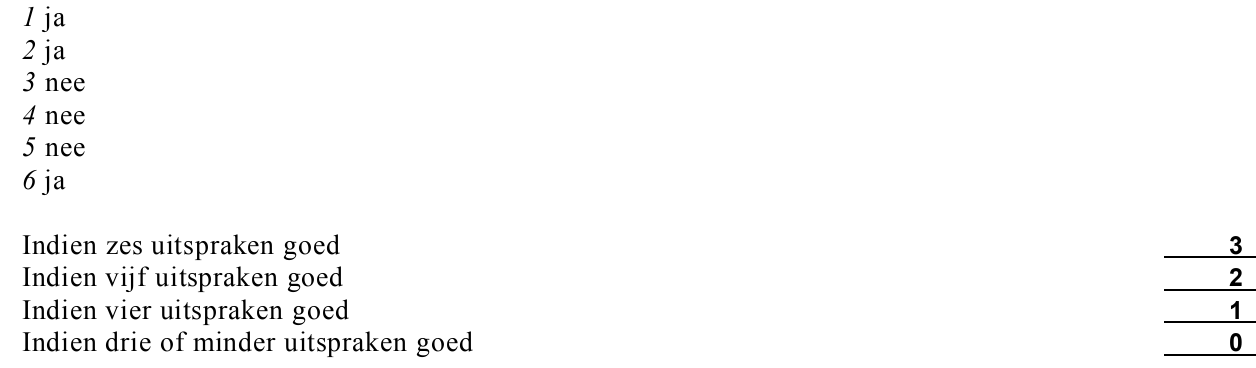
 Geef voor elk van de onderstaande uitspraken over de ik-persoon aan of deze wel of niet
 encouraging
 going to measure
 ignoring
 trying to stop
 Last but not least,
 On the other hand,
 Thus
 Yet
 excellent
 old
 shocking
 unexpected
 a covenant marriage
 each other’s shortcomings
 marriage for life
 the rules of the Church
 Besides
 However
 Likewise
 Therefore
 cannot
 could
 should
 will not
 church laws on marriage
 covenant marriages
 most divorce cases
 no-fault divorce laws
 conditions
 criticisms
 recommendations
 results
 end in divorce
 experience difficulties
 get official approval
 last for ever
 produce children
 Welke zin uit alinea 1 of 2 maakt duidelijk welk verschil er bestaat tussen de huidige
 Which of the following can be concluded from this sentence?
 Allison Pearson follows her mother’s example in the way she raises her child.
 Allison Pearson is a less authoritarian parent than her mother was.
 In the past parents hardly paid any attention to their children’s needs.
 Modern parents object to the strict way they were brought up.
 What is the main point made in paragraph 5?
 An unhappy childhood turns children into miserable parents.
 Children are no longer taught to respect their parents’ privacy.
 Modern parents no longer try to control their children.
 Problems that go with raising children are discussed openly nowadays.
 There are more and more TV programmes about parenting these days.
 What conclusion do paragraphs 6 and 7 lead up to?
 Children have always questioned their parents’ authority.
 Kate Figes’s approach to dealing with unruly children makes good sense.
 Modern mothers spend too much time and energy on their children.
 Recent theories about bringing up children have made parents uncertain.
 Waarom is dit voor vrouwen een probleem volgens alinea 8?
 What characterises the New Mother, according to paragraph 9?
 She has a career and devotes much of the remaining time to her children.
 She is capable of managing family life to her children’s satisfaction.
 She is prepared to share the responsibility for the children with her husband.
 She prefers her job to taking care of her husband and children.
 What is implied in the last paragraph?
 Children will eventually get used to new patterns in family life.
 It is virtually impossible for both parents of a family to have a full-time job.
 Modern parents have themselves to blame if their children act up.
 The old-fashioned way of raising children should not be re-introduced.
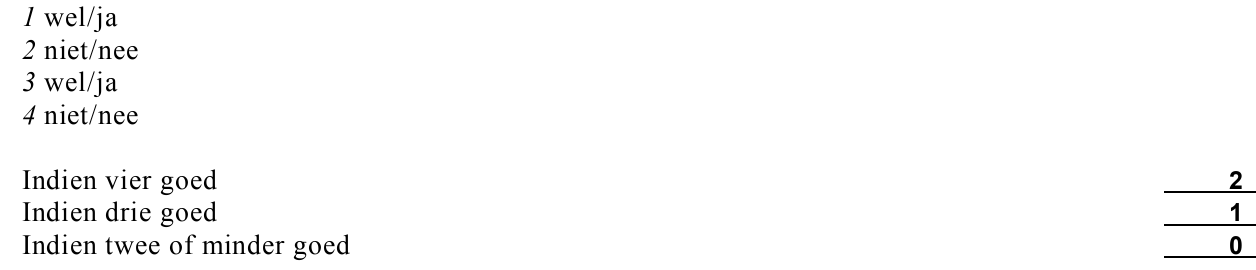
 Geef voor elk van de onderstaande middelen aan of dit voorkomt in het artikel A tyrant is born.
 What is the main point made in the first paragraph?
 British ministries struggled with staff shortages because many men had joined the army.
 British newspapers tried to entertain their readers by presenting more crossword puzzles
 the British armed forces had great difficulty deciphering the German naval codes.
 the British secret service attracted staff among newspaper readers who were good at solving
 What are the examples in the second paragraph meant to show?
 Crosswords have had great influence on the English language.
 Solving crosswords is a basic aspect of being British.
 The British are better than any other nation at designing crosswords.
 The origins of the crossword puzzle lie in the language of Shakespeare.
 What is the main function of the last paragraph?
 To express pity for the Bletchley code-breakers.
 To mock the Bletchley code-breakers.
 To praise the Bletchley code-breakers.
 Leg in één zin uit wat hiermee bedoeld wordt.
 Why does the writer conclude this?
 Because alternative medicine has turned out to be relatively cheap.
 Because patients can now choose between traditional and alternative treatments.
 Because several alternative treatments have proved to be effective.
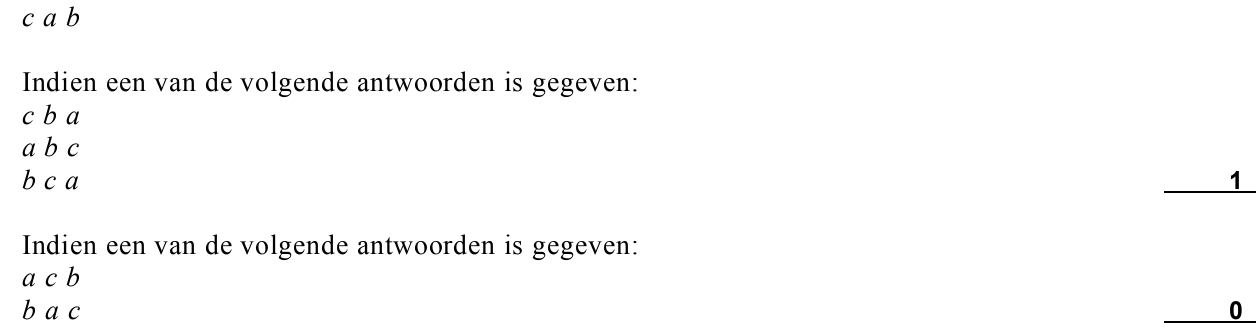
 In welke volgorde moeten deze alinea’s in de oorspronkelijke tekst hebben gestaan?
 What is the answer to this question, according to Dr Dalen (paragraph 5)?
 does not have a traditional university background.
 does not sufficiently research the effectiveness of its own therapies.
 fails to keep up with the latest scientific discoveries.
 is concerned with mental rather than with physical health.
 Which of the following medical terms from the article What’s ‘Alternative’? refers to the
 ‘primary-care physicians’ (line 5)
 ‘mainstream treatments’ (line 10)
 ‘Internal Medicine’ (line 16)
 ‘academic medicine’ (line 21)
 ‘Complementary Medicine’ (line 23)
 Which of the following becomes clear about the television series Psychos from paragraphs 1 and 2?
 It is causing indignation even before the first episode has been broadcast.
 It makes fun of mentally handicapped people.
 It presents a false picture of the way psychiatrists work.
 It promotes a new approach to dealing with psychiatric patients.
 How could paragraph 3 also start?
 After all, the programme-makers…
 For example, the programme-makers…
 However, the programme-makers…
 Moreover, the programme-makers…
 What is the main point made about Psychos in paragraph 4?
 It basically represents a romantic love story.
 It involves a very expensive advertising campaign.
 Its formula is similar to that of other drama series.
 Its main characters are played by well-known TV actors.
 What is the writer’s main aim in paragraph 5?
 To explain what makes Psychos special.
 To give examples of scenes from Psychos.
 To point out how difficult acting in Psychos is.
 To question whether Psychos is realistic.
 Welke andere alinea van het artikel illustreert het realistische beeld dat Psychos van de
 What is paragraph 6 mainly about?
 The effectiveness of the way hospitals treat mental patients.
 The policies proposed to improve the mental health service.
 The pressures of working in the psychiatric profession.
 The violence psychiatrists are confronted with at work.
 Wat is volgens het artikel het belangrijkste gevolg van deze situatie?
 What will the effect of Psychos be according to the writer?
 It may give the present treatment of psychiatric patients a bad name.
 It may stimulate young people to pursue a career in psychiatry.
 It will improve people’s insight into the state that psychiatric care is in.
 It will increase public awareness of the causes of mental illnesses.
 Staat er een boek bij waar Patrick Humphries niet enthousiast over is en dat je dus beter niet
 Heeft het zin om die in te sturen? Zo ja, wat gebeurt er volgens de tekst mee?
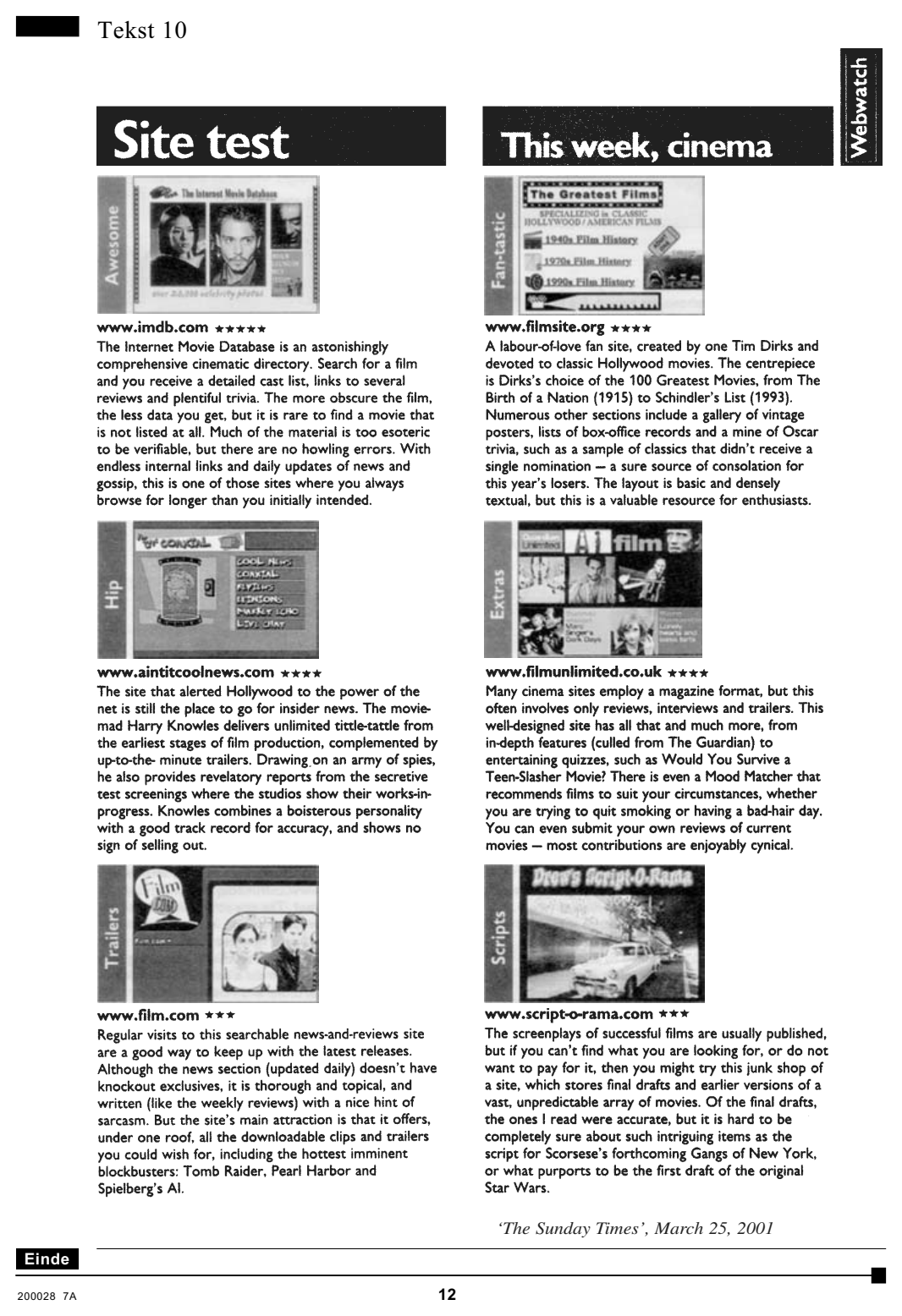
 Wordt op deze bladzijde zo’n website genoemd? Zo ja, wat is het webadres?

De bijlage met informatie bij dit examen, zoals hij gedrukt is.
Bij dit examen hoort geen uitwerkbijlage.
B
B
D
B
D
C
A
A
B
B
B
B
D

B
D
D

A
C
D
B
C

C
A
E
A
C
C
A

C

C


